
Local Customs and Culture in China
Tags:
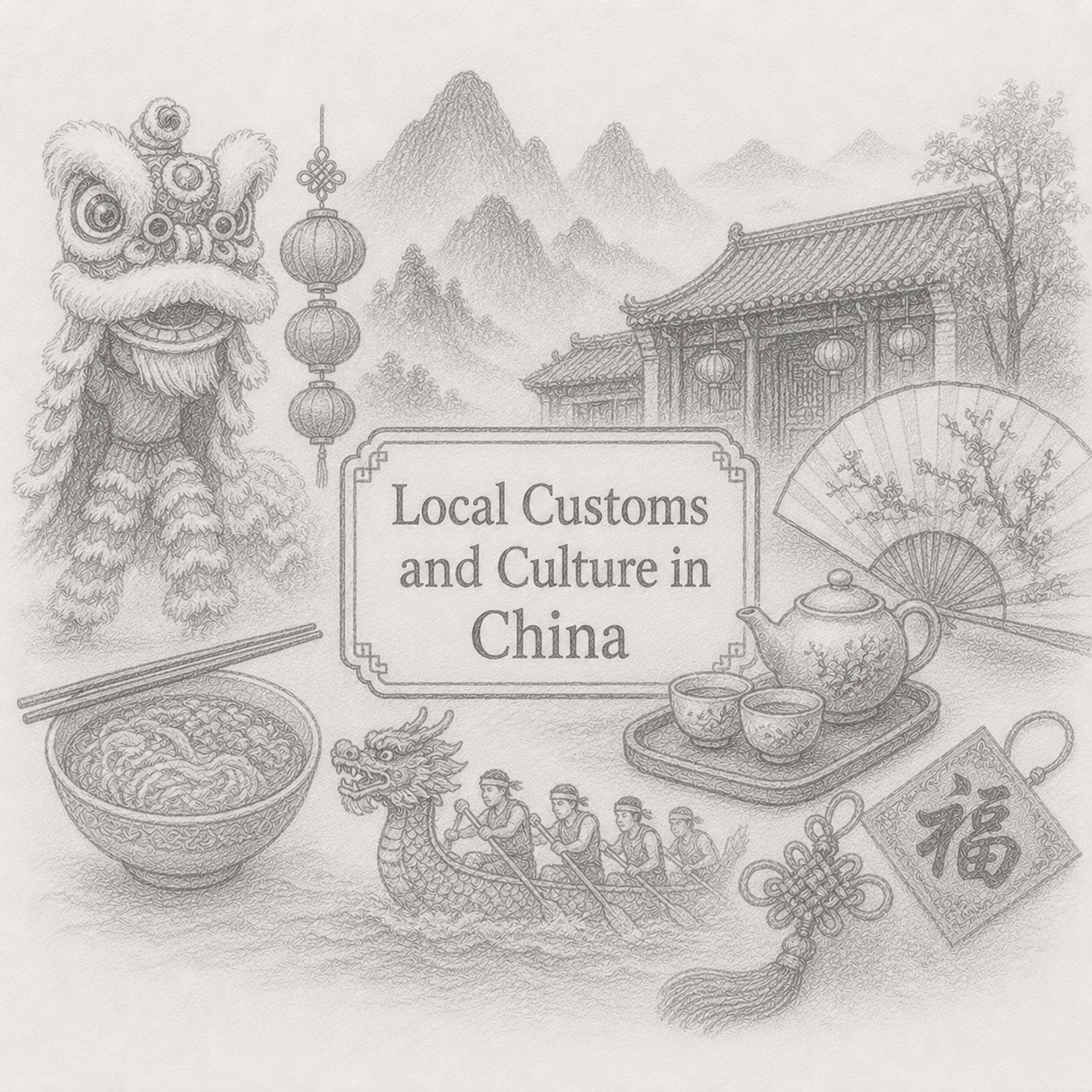
China is one of the most welcoming countries in the world for foreign visitors — and understanding a few local customs will make your experience even more enjoyable. 🇨🇳
Don’t worry: the Chinese are incredibly understanding of cultural differences and won’t expect you to be an expert. But making even a small effort goes a long way. A few words of Mandarin, knowing how to use chopsticks properly, or understanding why no one tips — these small things show respect and will earn you genuine smiles everywhere you go.
Here’s your guide to the customs, culture, and social norms you’ll encounter during the China Flow Retreat. 🙏
🤝 GREETINGS & SOCIAL ETIQUETTE
Chinese greetings are warm but often more reserved than what you might be used to in the West.
How to Greet People
- 👋 A smile and a nod — This is the most common casual greeting. Simple, warm, and always appreciated
- 🤝 Handshakes — Common in more formal settings. Keep it light and gentle — a firm Western-style grip can feel aggressive. A slight nod while shaking hands is a nice touch
- 🙏 拱手 (gǒng shǒu) — Hands clasped together with a slight bow. This traditional greeting is making a comeback and feels beautifully respectful
- 🚫 Hugs and cheek kisses — Not common between people who’ve just met. Save these for close friends once you’ve built a relationship
Useful Mandarin Phrases
Even a few words of Mandarin will light up people’s faces. You don’t need to be perfect — the effort alone is deeply appreciated!
- 🗣️ 你好 (nǐ hǎo) — Hello
- 🙏 谢谢 (xiè xie) — Thank you
- 😊 不好意思 (bù hǎo yì si) — Excuse me / Sorry (very useful!)
- 👍 好的 (hǎo de) — OK / Good
- 💰 多少钱?(duō shao qián?) — How much does it cost?
- 🍜 好吃!(hǎo chī!) — Delicious! (you’ll use this a lot!)
- 🍵 好喝!(hǎo hē!) — Tastes great! (for drinks/tea)
- 👋 再见 (zài jiàn) — Goodbye
💡 Pro tip: WeChat’s built-in translator can help you communicate in real time. Just type in English and it translates to Chinese — perfect for more complex conversations!
😊 THE CONCEPT OF "FACE" (面子 — MIÀNZI)
If there’s one cultural concept that shapes everyday life in China, it’s 面子 (miànzi) — “face.” Think of it as a combination of reputation, dignity, and social respect.
- ✅ Give face — Compliment people, especially in front of others. Praise someone’s cooking, their city, their English skills. This is always warmly received
- ❌ Don’t cause someone to lose face — Avoid publicly criticising, correcting, or embarrassing anyone. If there’s an issue, handle it privately and gently
- 🤷 Indirect communication — Chinese people often communicate indirectly to preserve harmony. A “maybe” or “it’s a bit difficult” often means “no.” Don’t push — read between the lines
- 🎁 Modesty is valued — If someone compliments you, it’s polite to deflect a little: “Oh, it’s nothing” rather than a big “thank you!” This shows humility
Understanding face isn’t complicated — it’s really just about being kind, respectful, and aware of others’ feelings. If that sounds like you already, you’ll fit right in! 💚
🥢 DINING CUSTOMS & CHOPSTICK ETIQUETTE
Food is at the heart of Chinese culture, and mealtimes are social, generous, and joyful. Here’s what to know:
Table Manners
- 🍽️ Meals are shared — Dishes are placed in the centre of the table and everyone helps themselves. It’s communal, social, and wonderful. Don’t be shy — dig in!
- 🥢 Use the serving spoon — When available, use the communal serving utensils (公筷 gōng kuài) rather than your personal chopsticks to take food from shared plates
- 🍚 Hold your bowl — It’s perfectly normal (and polite!) to lift your rice bowl close to your mouth while eating. Leaving it on the table and bending down to it is actually considered less polite
- 📱 Phone-friendly dining — Unlike in some Western cultures, it’s totally normal to check your phone during meals. No judgement!
- 🍻 Toasting — When clinking glasses, hold yours slightly lower than the other person’s as a sign of respect. Say “干杯!” (gān bēi!) — meaning “cheers!” (literally: “dry glass!”)
Chopstick Do's and Don'ts
Chopsticks have a few important etiquette rules:
- 🚫 Never stick chopsticks upright in rice — This resembles incense sticks at a funeral and is considered very bad luck. Lay them flat across your bowl or on the chopstick rest
- 🚫 Don’t point with chopsticks — Pointing at people with your chopsticks is considered rude
- 🚫 Don’t tap bowls with chopsticks — This is associated with begging and is considered impolite
- ✅ It’s OK to struggle! — If you’re not confident with chopsticks, nobody will judge you. Ask for a fork — restaurants are happy to provide one. But trying to use chopsticks (even clumsily) is always appreciated!
Paying the Bill
- 💰 “Fighting” for the bill — In Chinese culture, it’s common for everyone at the table to insist on paying. This friendly “battle” is a sign of generosity and hospitality. If someone insists on paying, accept graciously after a polite refusal or two
- 📱 Everything is digital — Most payments happen via WeChat Pay or Alipay. Cash is rarely used. Make sure you have your apps set up! (See our WeChat & Alipay guide)
💴 TIPPING — DON'T DO IT!
This is one of the biggest surprises for Western visitors: tipping is not customary in China — and in many cases, it can actually cause confusion or even offence. 😅
- 🚕 Taxis — No tip expected. Just pay the meter
- 🍜 Restaurants — No tip. The price on the bill is the price you pay
- 🏨 Hotels — No tip for housekeeping or bellhops (except in very international luxury hotels)
- 💇 Services — No tip for hairdressers, spa staff, etc.
The reason is deeply cultural: good service is considered part of the job, and offering extra money can imply that someone needs charity or that their employer doesn’t pay them enough.
The exception: Private tour guides may accept a tip as a gesture of appreciation — but it’s never expected.
Bottom line: keep your wallet closed after meals. It feels strange at first, but you’ll get used to it! 😄
🍵 TEA CULTURE — ESPECIALLY IN WUYISHAN!
You’re going to one of the most famous tea regions in the entire world. Wuyishan is the birthplace of Wuyi Rock Tea (岩茶 yán chá), a UNESCO-recognised variety of oolong that’s been cultivated here since the 16th century. 🏔️
Tea isn’t just a drink here — it’s an art form, a social ritual, and a way of life.
What to Expect
- 🫖 Gongfu tea ceremony — You’ll likely experience the traditional “功夫茶 (gōngfu chá)” preparation, where tea is brewed in tiny cups with precise water temperatures and steeping times. Each infusion reveals new flavours. It’s meditative and beautiful
- 🍵 Tea is offered everywhere — In shops, at meetings, when visiting someone’s home. Accepting tea is a sign of respect and friendliness
- 👆 The “thank you” tap — When someone pours tea for you, gently tap the table twice with two fingers. This silent “thank you” is a wonderful local custom with a legendary origin (ask a local — they love telling the story!)
- ♻️ First brew is discarded — Don’t be surprised when the first pour is thrown away. This “washes” the leaves and opens them up for the real brewing
- 🍃 Try Da Hong Pao — The most famous Wuyi Rock Tea. Rich, mineral, complex — some of the world’s most expensive tea comes from these mountains. You’ll get to taste it fresh from the source!
💡 Pro tip: Buying tea directly from local producers in Wuyishan is an incredible experience — the quality is outstanding and the prices are a fraction of what you’d pay abroad. It makes a perfect gift to bring home! 🎁
🚫 THINGS TO AVOID — CULTURAL TABOOS
China is very forgiving of cultural mistakes from foreigners, but here are a few things worth knowing:
Numbers & Colours
- 4️⃣ The number 4 — Considered unlucky because it sounds like the word for “death” (死 sǐ). Many buildings skip the 4th floor. Avoid giving gifts in sets of four
- 🔴 Red = lucky! — Red is the colour of prosperity, happiness, and good fortune. You’ll see it everywhere — lanterns, decorations, money envelopes
- ⚫ White and black — Associated with mourning and funerals. Avoid wrapping gifts in white or black paper
- 🟢 Green hats — Here’s a fun one: never wear a green hat! The Chinese expression “wearing a green hat” (戴绿帽子) means your partner is being unfaithful. It’s a genuine cultural taboo that catches most tourists off guard 😄
Social Don'ts
- 🕐 Don’t give clocks as gifts — “Giving a clock” (送钟 sòng zhōng) sounds exactly like “attending a funeral” (送终 sòng zhōng). Same goes for umbrellas (伞 sǎn sounds like “separation” 散 sàn)
- 👉 Don’t point with your finger — Use your whole open hand to gesture instead
- 📸 Ask before photographing people — Especially elders, monks, or anyone at a temple. A smile and a gesture goes a long way
- 🏛️ Temples and sacred sites — Dress modestly (cover shoulders and knees), keep your voice low, and follow any posted rules. Remove shoes when asked
- 💑 Public affection — Hand-holding is fine, but kissing and hugging in public is considered too intimate by most locals, especially in rural areas
🏙️ DAILY LIFE — PRACTICAL CUSTOMS
These everyday customs will help you navigate daily life smoothly:
Queuing & Personal Space
- 🧍 Queuing culture varies — In big cities, queuing is orderly. In smaller towns and rural areas, it can be more… fluid. Don’t be surprised if someone stands very close or cuts in line — it’s not considered rude in the same way. Stay relaxed and go with the flow!
- 📏 Personal space is smaller — Chinese people are generally comfortable standing closer together than Westerners. This is especially noticeable on public transport and in markets
Bargaining
- 🛍️ Bargaining is expected at markets and small shops — Start at about 50-60% of the asking price and work your way to a fair deal. It’s social and fun!
- 🏪 Fixed prices in supermarkets, chain stores, and restaurants — Don’t try to bargain here!
- 😊 Keep it friendly — Bargaining is a conversation, not a confrontation. Smile, joke, and enjoy the process
Bathrooms
- 🚻 Squat toilets are common — Especially outside big cities. They’re more hygienic than you’d think — you’ll get used to them quickly!
- 🧻 Always carry tissue paper — Many public bathrooms don’t provide it. Keep a small pack in your bag at all times
- 🚮 Don’t flush paper — In many places, used tissue goes in the bin next to the toilet, not in the bowl. The plumbing often can’t handle paper
Safety
- 🔒 China is very safe — Violent crime is extremely rare. You can walk around at night without worry in most areas
- ⚠️ Watch for scams — The classic “tea house scam” (someone invites you for tea then leaves you with a huge bill) is rare but still exists in tourist areas. If a stranger invites you somewhere, be cautious
- 📱 Keep your phone charged — Your phone is your wallet (WeChat/Alipay), your translator, your map, and your taxi-hailing device. A portable power bank is essential!
🎁 GIFT GIVING — IF YOU WANT TO BRING SOMETHING
Gift-giving is a meaningful part of Chinese culture. If you want to bring something for your hosts or new friends at the retreat, here are some guidelines:
Good Gift Ideas
- ✅ Specialty foods from your country — Chocolate, cheese, local snacks, wine, or spirits. These are always a hit!
- ✅ Tea or coffee from home — Even in the tea capital of the world, people appreciate trying something different
- ✅ Quality items from your country — Anything that represents where you’re from: Dutch stroopwafels, French macarons, Australian Tim Tams…
- ✅ Something handmade — As flow artists, you have an edge here! Something personal and creative is deeply valued
Gift Etiquette
- 🤲 Give and receive with both hands — This shows respect and sincerity
- 🎀 Red wrapping = lucky! — Red or gold wrapping is ideal. Avoid white, black, or blue
- 📦 Gifts may not be opened immediately — Don’t be offended! Opening gifts in front of the giver can be seen as greedy. They’ll appreciate it privately
- 🚫 Avoid: clocks, umbrellas, sharp objects (scissors, knives), and anything in sets of 4
- ✅ Lucky numbers: 6, 8, 9 — If you’re giving a set of something, these numbers are considered fortunate
💚 EMBRACE THE EXPERIENCE
The most important “custom” to follow? Be open, curious, and kind.
China will surprise you in the best ways. The generosity of strangers, the incredible food, the ancient tea culture in Wuyishan, the laughter over shared meals — these moments will stay with you long after the retreat ends.
You don’t need to memorize every cultural rule. Just approach everything with genuine respect and a sense of adventure, and you’ll be welcomed with open arms. 🤗
As we say in Chinese: 入乡随俗 (rù xiāng suí sú) — “When in Rome, do as the Romans do.” Or more literally: “Enter the village, follow the customs.” 🏡
📖 MORE CHINA FLOW RETREAT GUIDES
Explore our other guides to prepare for your trip:
- Why It’s So Cheap to Fly to China Right Now — Real price examples
- Visa Regulations in China — You probably don’t need one!
- Flying with Fire & LED Props — Pack your gear like a pro
- How to Get to the Retreat — All travel routes explained
- Install WeChat & Alipay — Essential apps for China
- Taxi & Train Tickets Guide
- China Travel Essentials — What to bring & prepare
See you in Wuyishan! 🏔️🔥🍵
[…] Local Customs and Culture in China Local Customs and Culture in China Read More […]
[…] Blog Install and use WeChat & AliPay apps Install and use WeChat & AliPay apps – China Flow Retreat Tags: App installation China Flow Reteat Pay in China… Blog Travel from Fuzhou Airport to the China Flow Retreat Travel from Fuzhou Airport to the China Flow Retreat Tags: China China Flow Retreat Fuzhou Train Travel Travel Guide Wuyishan… Blog Travel from Shanghai to the China Flow Retreat Travel from Shanghai to the China Flow Retreat Tags: Flying into Shanghai and heading to the China Flow Retreat in… Blog Travel from Wuyishan Airport to the China Flow Retreat Travel from Shanghai to the China Flow Retreat Blog How to hail a taxi & book high-speed rail tickets in China Blog How to get to the China Flow Retreat How to get to the China Flow Retreat Tags: China China Flow Retreat Fuzhou Shanghai Travel Travel Guide Wuyishan The… Blog China Travel Essentials: What to Bring & What to Prepare – China Flow Retreat China Travel Essentials: What to Bring & What to Prepare – China Flow Retreat Tags: China China Flow Retreat Flow… Blog Visa regulations in China Visa regulations in China Tags: China China Flow Retreat Travel Travel Guide Visa Thinking about traveling to China? Here’s the… Blog Why It’s So Cheap to Fly to China Why It’s So Cheap to Fly to China Right Now Tags: China China Flow Retreat Flights Travel Travel Guide Let’s… Blog Local Customs and Culture in China […]